
Departmental Resources
Undergraduate Laboratory
About
The UG lab provides technical training to Chemical and Biochemical Engineering undergraduate students. The B.Tech.s can perform experiments that help them relate to the concepts studied in their lecture courses. The lab is well equipped with experimental setups catering to four different core areas of Chemical Engineering namely heat transfer, mass transfer, fluid particle mechanics and fluid mechanics. The lab also has a separate instrumentation facility which houses equipments like a rheometer, Brunauer–Emmett–Teller (BET), Zetasizer, tensiometer and particle size analyzer. In addition, there is space for 50 students to sit and discuss their results in a calm environment.
In the first lab session, students are introduced to the theoretical background required to understand a particular experiment. In addition, students are made familiar with lab safety and Material Safety Data Sheets (MSDS) along with proper instruction manuals. Once the students understand the basic knowhow of how to conduct an experiment, they are divided into groups and allowed to perform the experiment under proper supervision of faculty and lab staff. The students are encouraged to tinker with the existing equipments while safeguarding safety standards. All chemical required to perform the experiments are provided by the laboratory.
The broad objectives of the lab are to:
1) Perform experiments and correlate obtained data to reported literature values 2) Design and develop new apparatuses and technologies
Instructions for students
1) Don’t miss the first lab session 2) Follow all instructions and safety guidelines carefully 3) Come dressed in proper attire. Lab coats and closed shoes are mandatory while working in the lab. 4) Clean up after your experiment so that the equipment is ready to use by the next group 5) Get your readings signed by your supervisor before leaving the lab 6) Keep your phones switched off at all times
Description of Experiments
1) Mass Transfer Operations
Vapor Liquid Equilibrium (VLE)
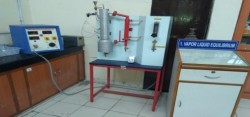 VLE data is basis of distillation column design and operation which is important unit of chemical industry. Equilibrium is a static condition in which no changes occur in the macroscopic properties of a system with time. Vapor liquid Equilibrium is a condition where a liquid and its vapour are in equilibrium with each other, a condition or state where the rate of evaporation is equal to the rate of condensation; one a molecular level such that there is no net vapour liquid interface transfer
Mass transfer with and without Chemical reaction
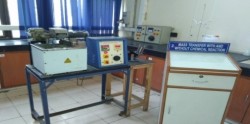 The dissolution may occur with or without chemical reaction. In case dissolution is accompanied by solid-liquid reaction, it is desirable to estimate the enhancement in the rate of mass transfer due to simultaneous reaction as compared to mass transfer without reaction. The estimated enhancement factor is compared it with that predicted on the basis of the film and the boundary layer models. Here the system under studyis dissolution of benzoic acid in aqueous NaOH solution. The dissolution of a solid in a solution accompanied with instantaneous chemical reaction.
Adsorption in packed bed
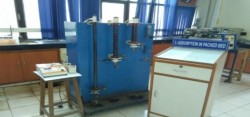
Adsorption in a surface phenomena where atoms, molecules or ions of liquid, dissolved solid or gases adheres to a surface. It is selective transfer of a solute from a liquid phase to a batch of rigid particles. Packed bed consist of different diameter and length introduced here to study the breakthrough curve of adsorption for this system and calculation of length of unused bed for the system is determined. Packing material in small pellets form of activated charcoal is used which is highly porous, amorphous solid consisting of microcrystallines with a graphite lattice. One of the well known operations for solid-liquid contacting is adsorption.
Wetted wall column
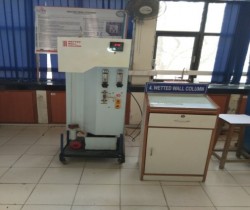 A thin film of liquid falling down the inside of a vertical pipe through which the gas flows, constitutes a wetted wall column. Wetted wall columns have been used as absorbers for water moisture and other volatile liquids. The height of wetted wall column required for mass transfer operations is excessive and consequently this is not widely used, where large quantities of liquid or gas have to be handled, it would be necessary to arrange many vertical pipes in parallel and this leads to difficulties in the distribution of liquid into the inner surface of the tubes. The gas pressure drop for this is confined to skin friction effects, with few or no expansion or contraction losses. The mass transfer rates for fluids flowing through pipes have been studied more completely than other cases. The rates of diffusion into gases flowing through pipes have been studied in wetted wall columns.
Mass transfer coefficient
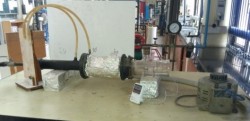 The rate of mass transfer is strongly related to the mass transfer coefficient. The estimation of mass transfer coefficient is very useful in design and optimization of mass transfer equipments employed for separation, and also to solve real life problems like chemical spillage. To find the mass transfer coefficient for flow of air over a single sphere of naphthalene.The contacting unit is a glass pipe with a naphthalene ball held stationary at the center of the pipe. Air is blown through the pipe in order to create mass transfer by forced convection.The mass transfer coefficient is estimated and compared with the empirical correlation.
Diffusion Coefficient
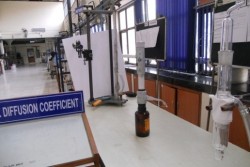 Here in this setup, we study the diffusion coefficient of acetone vapour in air using Stefan’s Tube apparatus.Diffusion describes the spread of particles through random motion from regions of higher concentration to regions of lower concentration. The time dependence of the statistical distribution in space is given by the diffusion equation. The concept of diffusion is tied to that of mass transfer driven by a concentration gradient. If two gases are inter diffusing with continual supply of fresh gas and removal of the products of diffusion, this diffusion reaches an equilibrium state with constant concentration gradients. The diffusion coefficient can be estimated under the pseudo-steady state condition.
Liquid Liquid Extraction Column
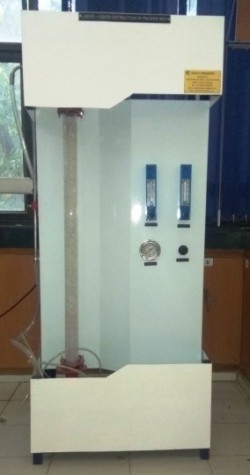 Liquid-liquid extraction works on the principle of solubility i.e. chemical structure difference. This process is used industrially inFermentation and Algae Broths, Phenol from Wastewater,Acetic Acid Extraction, essential oil extraction, Neutralization/washing of acids or bases from organic stream. Liquid extraction or solvent extraction, is the separation of the constituents of a liquid solution by contact with another insoluble liquid. If the substances constituting the original solution distribute themselves differently between the two liquid phases, a certain degree of separation will results, and this can be enhanced by use of multiple contacts or their equivalent in the manner of gas absorption and distillation.
Towers filled with some random packing are widely used for extraction of valuable chemicals from dilute solutions by liquid-liquid extraction. The packing provides a larger extract area for mass transfer and also reduces the axial mixing to some extent.
2) Heat Transfer
Unsteady State Heat Transfer
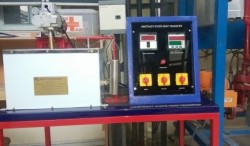 This laboratory exercise is aimed to investigate the heat transfer response of solid objects of various geometrical shapes that are suddenly exposed to convection with a fluid at a constant temperature. This configuration can be extended to many practical applications by using the lupmped capacitance method to model the transient heat transfer. The overall objective of this experiment is to investigate how the shape and material selection affects the transient heat tansfer response of the system. Additionally, the non-dimensional parameters related to transient heat transfer are used to analyse the response for different materials.
Heat transport through composite wall
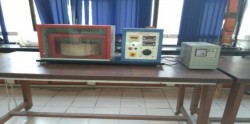 The experiment analyzes the Fourier law of heat conduction in a composite solid by measurement of temperature distribution.Conduction (heat transfer by diffusion) is the transport of energy from the more energetic to the less energetic particles of a substance due to a temperature gradient, and the physical mechanism is that of random atomic and molecular activity. For one-dimensional, steady-state heat conduction in a plane wall with no heat generation, temperature is a linear function of the x coordinate For a composite slabs, while the heat flux is same in both slabs, the temperature gradient is inversely proportional to the thermal conductivity of the slab.
Heat transfer through natural convection
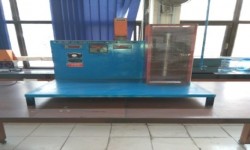 To determine the convective heat transfer coefficient for a heated vertical cylinder losing its heat to the ambient by free or natural convection. In contrast to the forced convection, natural convection phenomenon is due to the buoyancy driven flow of ambient fluid and is not created by any external agency. The present experimental set up is designed and fabricated to study the natural convection phenomenon from a vertical cylinder in terms of the variation of local heat transfer coefficient along the length and also the average heat transfer coefficient and its comparison with the value obtained by using the empirical correlation.
Shell and tube heat exchanger
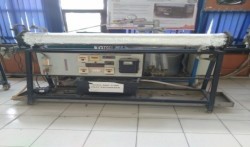 The most common type of heat exchanger is the shell and tube heat exchanger. It is found in every chemical industry. This type of heat exchanger consists of a shell with a bundle of tubes inside it. One fluid runs through the tubes, and another fluid flows over the tubes (through the shell). The heat is transferred from the hot fluid to the cold fluid. The rate of heat transfer depends on the overall heat transfer coefficient. The aim of the experiment is to determine the overall heat transfer coefficient and to determine the efficiency & effectiveness of the heat exchanger.
Multi effect evaporator
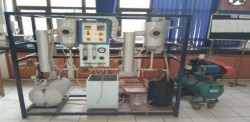 Chemical industry like Chlor-Alakali, Sugar manufacturing cannot be imagined without the Multiple-effect evaporator. Evaporation deals with concentration of a non-volatile solute from a solution by the removal of required amount of volatile solvent. Usually the solvent is water. By vaporizing a part of the solvent, useful product i.e. the concentrated solution or thick liquor is produced and the vapor is discarded.Here in our laboratory practices, we study the double effect evaporator in which the dilute solution is fed to the first evaporator from feed tank by creating a pressure difference through compressor.The vapor generated in the first evaporator is used as the heating medium for the second evaporator. The capacity and efficiency of the double effect evaporator is estimated.
Refrigeration test RIG
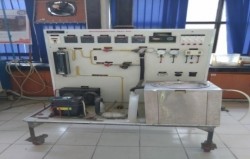 To understand the performance of a vapour compression refrigeration cycle.The term refrigeration implies the maintenance of a temperature below that of the surroundings. Vapour compression refrigeration cycle is one of the methods by which one can achieve the above effect. The thermodynamic cycleconsists of evaporation, compression, condensation and expansion of a refrigerant. The coefficient of performance of the refrigeration cycle is estimated for a given cooling load.
Expansion Process of Gases
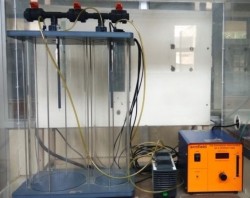 This system is introduced to Under Graduate Students to make them understand the isothermal and adiabatic expansion process of the gases. How slow or how fast theyoccur in chemical engineering processes. There are two tanks and one air pump is fitted into this system. The first one is treated as pressure tank while second one is vacuum tank. And air is taken from air pump to pressure tank and then both process i.e. isotheral and adiabatic are practiced. The applicability of ideal gas law is checked for a slow expansion under isothermal condition.
3) Fluid Particle Mechanics
Blaine’s Apparatus
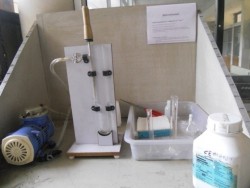 This apparatus is widely used in cement, ceramic, tiles manufacturing industry for the determination of specific surface area. The quality of cement is determined based on Blaine No. Basic aim of this experiment is to determine the porosity and the specific surface area of non-porous powder. This experiment employs the principle of fluid flow through packed bed.
It consists of vacuum pump, a manometer and sample holder. Many other properties of non porous powder can be determined with the help of Blaines Apparatus.
Fluidized Bed (Liquid-Liquid and Gas-Solid)
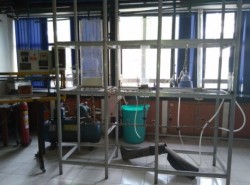 Fluidized beds have been widely used in processes involving gasification, pyrolysis and combustion of a wide range of particulate materials including biomass. However, only a limited research has been performed to investigate the hydrodynamics of biomass particles. Advantages of fluidization include high heat transfer, uniform and controllable temperatures, favorable gas–solid contacting and the ability to handle a wide variation in particulate properties. Both low-velocity bubbling fluidized beds and high-velocity circulating fluidized beds (CFB) have been utilized in these processes.
In our laboratory, we allow students to perform both liquid-solid fluidization and gas-solid fluidization for their better understanding of these processes. The conditions for the onset of fluidization as well as the elutriation process are studied using a lab sale fluidization column.
Packed Bed
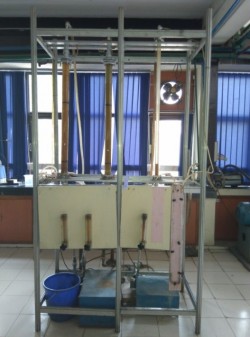 There are many engineering applications that utilize a packed bed. The forms more commonly implemented today are incorporated with systems involving adsorption of a solute, distillation, filtration and separation (e.g. water purification via waste removal). In an ion exchange or catalytic reactor, a single fluid (liquid or gas) flows through a bed of densely compacted granules used.
In our laboratory we have two packed column consist of glass beads and raschig rig packing. This system is used to understand the relationbetween the flow rate and pressure drop across the packed bed. The role of the packing geometries in pressure drop is analyzed. While the irresular shapes, like rashig rings, offer greater surface area for solid-fluid contact, thesepackings exhibit higher pressure drop in comparison to the regular spherical packings.
Stokes Law Experiment
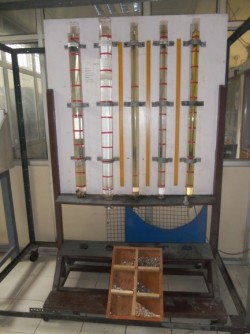 It is describing the resisting force on a particle moving through a viscous fluid and showing that a maximum velocity is reached under gravity.
In air, the same theory can be used to explain why small water droplets (or ice crystals) can remain suspended in air (as clouds) until they grow to a critical size and start falling as rain (or snow and hail).Similar use of the equation can be made in the settlement of fine particles in water or other fluids. Stokes' law is important for understanding the swimming ofmicroorganism.
In our laboratory, students perform many experiment with different viscosity of liquid with different density and shape of particles. The verification of Stokes’ Law is performed and terminal velocity can be studied.
Sedimentation
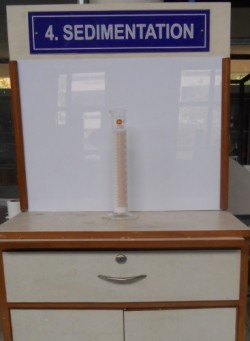 Settling is the falling of suspended particles through the liquid, whereas sedimentation is the termination of the settling process.Sedimentation is the tendency for in suspension to settle out of the fluid in which they are entrained and come to rest against a barrier.Settling is the process by which particles heavier than liquid medium settle to the bottom of a liquid and form sediment (or concentrated slurry). In the gravity settling, two main forces acting on particles: the apparent mass such as gravity and a drag force that is due to particle motion in fluid. As many particles are settling, the motion of the particles can be considered as hindered settling. The relative motion of particles can be determined by Richardson and Zaki relation, provided the terminal velocity of the settling particles is known.Experimentally one can easily determine the height of the interface of clear liquid and slurry from the bottom of the flask at different time. This can be utilized to determine the velocity of settling particles, which is required to design the area of a settling tank.
Particle Size Distribution (Sieve Analysis and Ball mill)
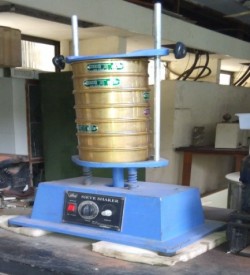 For the characterization of bulk goods of different forms and sizes, the knowledge of their particle size distributions is essential. The particle size distribution, i.e. the number of particles of different sizes, is responsible for important physical and chemical properties such as solubility, flowability and surface reaction.It is one of basis technique used for determination of particle size distribution. There are two processes involves with sieving; dry and wet sieve analysis. We uses dry sieving in our laboratory practices. Industry where sieving is used are mineral processing, cement, ceramic, pharmaceutical, cosmetic etc. Dry sieving is the preferred method for the size range between 40 µm and 125 mm. However, the measurement range is limited by properties of the sample such as a tendency to agglomerate, density or electrostatic charging.
4) Fluid Mechanics
Centrifugal Pump Study
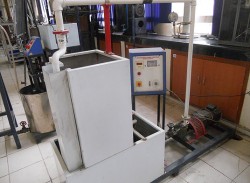 Chemical Industry consist of all kind of pump and among them most common is cenrifugal pump. In our lab,
it is intended to the pump charactersitic curve. There is provision to measure varrying rpm with suction and
dicharge pressure and flow rateas well.
Flow Meter Study
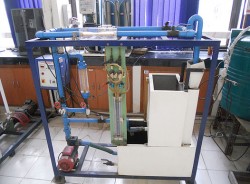 This single set up consist of all three
flowmeter; Rotameter, Orifice meter and venturimeter.
Plate and Frame Filter
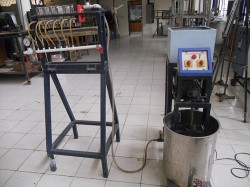 This process imply study of filtration of slurry.
Student Activities

Videos
Motivational Lecture by DRDO ScientistMotivational Lecture by DRDO Scientist Hands On Training
Team

Dr. Anil Verma Co-Ordinator Associate Professor Qualification: PhD(Chemical) IIT Delhi, 2005, B.Tech, M.Tech(Chemical), HBTI Kanpur Email: anilverma@chemical.iitd.ac.in

Mr. Narendra Kumar Lab- Incharge Junior Technical Superintendent UG Lab, Dept .of Chem. Engg. IIT Delhi Qualification: B.Sc(Chemical Engg) BIT Sindri, 2008 Email: a26846@chemical.iitd.ac.in

Mr. Aashish Nayak Junior Technical Superintendent UG Lab, Dept .of Chem. Engg. IIT Delhi Qualification: Diploma(Mechanical Engg) BA Polytechnic Delhi Email: a27067@chemical.iitd.ac.in

Mr. Sanjiv Senior Mechanic UG Lab, Dept .of Chem. Engg. IIT Delhi Qualification: Diploma(Chemical Engg) Govt. Poly. Sonepat, 2008, Pursuing AMIE Email: a27070@chemical.iitd.ac.in

Mr. Ram Kumar Pandey One of the most senior person Email: a50621@chemical.iitd.ac.in
Contact Us
Phone number +91-26596175 Address RoomNo. 174 & 175, Block-II, Departmentof Chemical Engineering, IIT Delhi-110016 uglabchemical@gmaill.com